 NoiseGauge
How loud is too loud? Decibel levels and safe times
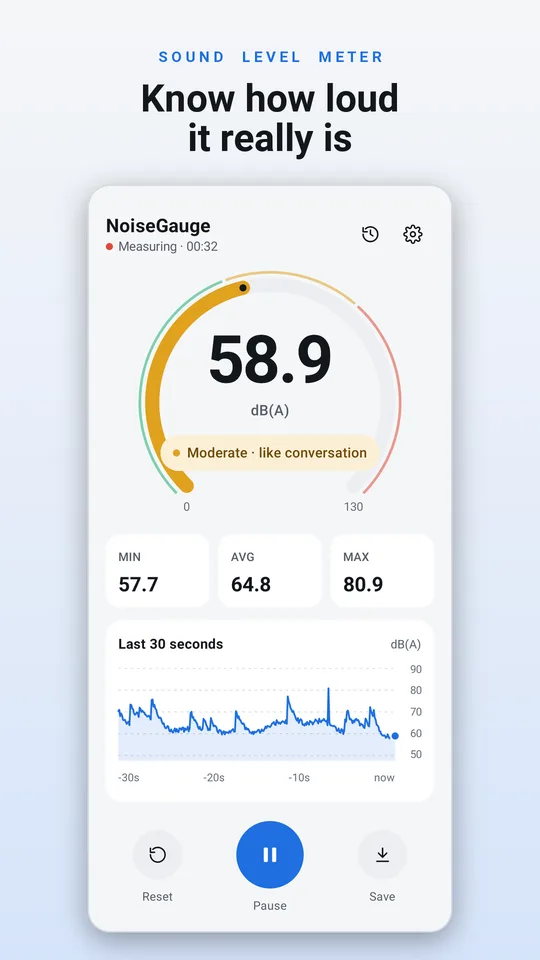
Sound starts to risk your hearing at around 85 dB(A) for 8 hours a day. For every 3 dB louder, the safe time halves: 88 dB for 4 hours, 91 dB for 2 hours, and at 100 dB only about 15 minutes. Damage builds up over years and doesn't come back, so it's worth knowing how loud your day really is.
What a decibel is, briefly
Decibels (dB) measure sound pressure on a logarithmic scale. Every +10 dB sounds roughly twice as loud to you, and every +3 dB is twice the sound energy reaching your ears. That's why a few decibels matter so much for hearing safety. Measurements for hearing are usually A-weighted, written dB(A), which matches how sensitive our ears are to different pitches.
How loud are everyday sounds?
Typical levels, measured at the listener. Real values vary with distance and the room.
| Sound | About |
|---|---|
| Quiet bedroom at night | 25–35 dB(A) |
| Library, quiet office | 40–50 dB(A) |
| Normal conversation at 1 m | 55–65 dB(A) |
| Busy restaurant | 70–80 dB(A) |
| Heavy city traffic, from the sidewalk | 80–85 dB(A) |
| Lawn mower, blender, hair dryer close up | 85–95 dB(A) |
| Subway train, motorcycle | 90–100 dB(A) |
| Concert, nightclub | 100–110 dB(A) |
| Siren or fireworks close by | 120 dB(A) and more |
Safe listening times
The US National Institute for Occupational Safety and Health (NIOSH) recommends a limit of 85 dB(A) averaged over 8 hours, with a 3 dB exchange rate. Many hearing experts use the same numbers for everyday life:
| Average level | Time to reach a full daily dose |
|---|---|
| 85 dB(A) | 8 hours |
| 88 dB(A) | 4 hours |
| 91 dB(A) | 2 hours |
| 94 dB(A) | 1 hour |
| 97 dB(A) | 30 minutes |
| 100 dB(A) | 15 minutes |
| 106 dB(A) | under 4 minutes |
The US workplace regulator OSHA uses a looser rule (90 dB for 8 hours, halving every 5 dB). It's a legal minimum for employers, not a safe level. For music through headphones, the World Health Organization suggests staying under about 80 dB(A) for no more than 40 hours a week, and 75 dB(A) for children.
Signs it's too loud, without a meter
- You have to raise your voice to talk to someone an arm's length away. That's roughly 85 dB or more.
- Your ears ring or sound muffled afterwards. That's a temporary threshold shift: a warning, even if it fades by morning.
- Sounds seem painful or distorted.
How to protect your hearing
- Turn it down or step back. Doubling your distance from a source drops the level by up to 6 dB, which more than doubles the safe time.
- Take breaks in a quiet place during long loud events.
- Wear protection. Foam earplugs cut 20–30 dB when they're inserted properly; musician's earplugs cut less but keep music clear.
- Watch the total, not the moment. A loud hour on the commute and an evening concert add up.
Measuring it with your phone
A sound meter app gives you the level now, the average over time and the loudest moments. Hold the phone at about the position of your ears, don't cover the microphone (usually at the bottom edge), and measure for at least a minute. Look at the average or Leq for exposure, not the peaks. Phone microphones aren't certified meters and often read low above about 100 dB, so treat very loud readings as "at least".
Phone microphones aren't certified sound level meters. Readings are estimates; see our terms.